Physical Address
304 North Cardinal St.
Dorchester Center, MA 02124
Physical Address
304 North Cardinal St.
Dorchester Center, MA 02124

Roulette attracts more betting systems than any other game. They fail for the same reason, and it’s worth understanding which one you’re being sold.
Roulette attracts more systems than any other casino game. Spin-reading, doubling after losses, tracking hot numbers, waiting for streaks — all of them promise an edge, and all of them fail in the same place.
Worth knowing where, so you can recognise the next one.
The claim: watch how hard the croupier releases the ball and you can predict roughly where it lands, often on the opposite side of the wheel.
Why it fails: the ball hits deflectors, bounces unpredictably across pockets, and the wheel is spinning independently in the opposite direction. The number of bounces alone destroys any relationship between release force and final pocket. Croupiers also vary their release and change tables regularly.
Online, it’s worse. There’s no physical spin to read at an RNG table, and even at live dealer tables, the camera angle and streaming delay remove any observation you’d theoretically need.
Anything framed as “not guaranteed, but powerful” is still selling an edge it can’t deliver.
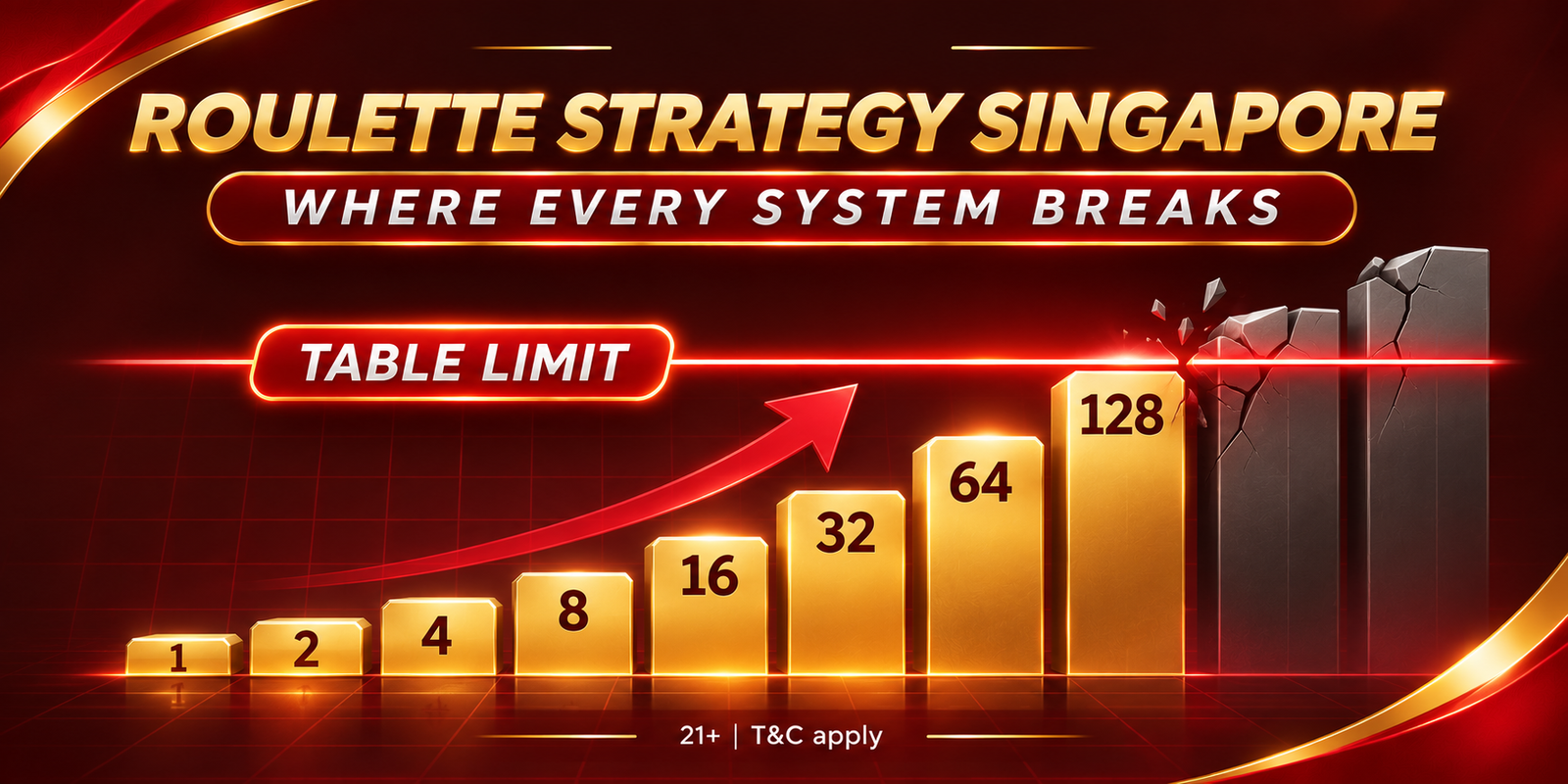
The Martingale. Bet one unit on red; if it loses, bet two; then four, eight, and so on. The first win recovers everything plus one unit.
The maths is correct. The problem is what it requires.
Ten consecutive losses means staking 1, 2, 4, 8, 16, 32, 64, 128, 256, 512 — a total of 1,023 units risked to win one. And ten consecutive losses on red isn’t exotic: it happens roughly once in every 800 sequences. Over a few hundred spins, you will see it.
Two things then stop you: the table maximum, which exists precisely to cap this, and your own bankroll. Both arrive long before the system “works.”
What Martingale actually does is convert many small wins into one catastrophic loss. The expected value doesn’t change at all — it just rearranges when the loss happens.
The claim: certain numbers are running hot, or a number that hasn’t appeared is due.
Why it fails: the wheel has no memory. Each spin is independent, and previous results carry no information about the next one. A number appearing five times in a row doesn’t change its chance of appearing again, and a number absent for 200 spins isn’t owed anything.
This is the gambler’s fallacy, and it’s the most expensive belief in any casino. The display boards showing recent results exist to encourage it.
Every betting system changes the same thing: the shape of your results, not the total.
Flat betting produces steady, gradual outcomes. Progressive systems produce many small wins and occasional large losses. Reverse progressions do the opposite. All of them have the same expected cost per unit staked — 2.7% on a European wheel, 5.26% on American.
Choosing a system is choosing what your session feels like, not what it costs.
There’s no strategy that beats roulette, but there are decisions that genuinely matter:
For what each bet type actually pays, see roulette odds explained. For how roulette compares to other games, see house edge explained.
Terms and conditions apply. 21+ only. Please bet responsibly.