Physical Address
304 North Cardinal St.
Dorchester Center, MA 02124
Physical Address
304 North Cardinal St.
Dorchester Center, MA 02124

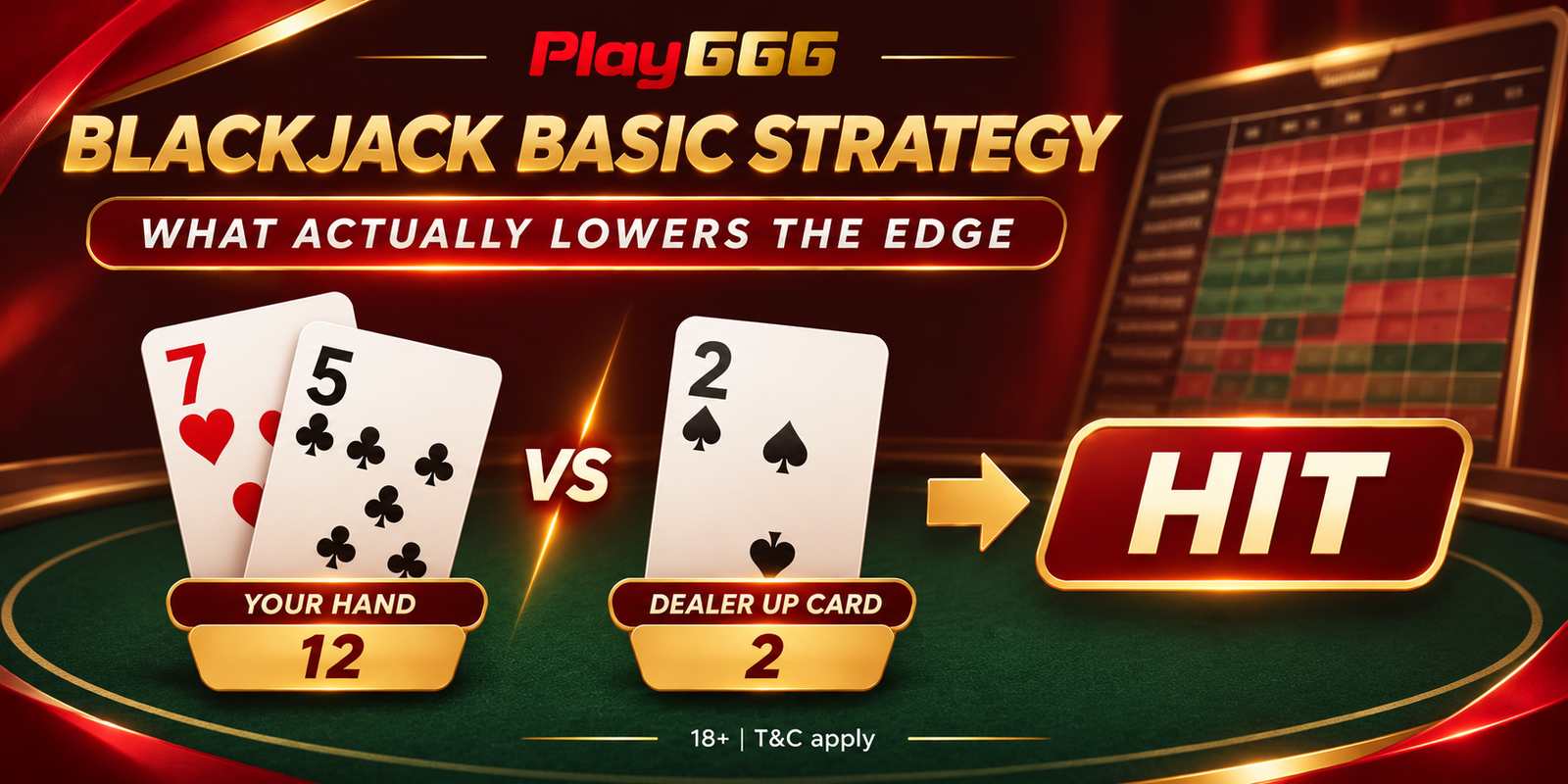
Blackjack rewards correct play more than almost any casino game. The problem is how much of the advice written about it is wrong in specific, costly ways.
Blackjack is unusual among casino games: your decisions genuinely change the outcome. In roulette or slots, nothing you do after the bet affects anything. In blackjack, playing correctly instead of by instinct is worth several percent.
That makes it the one game where advice is worth reading — and also the game where bad advice costs the most. A lot of what circulates is wrong in specific, expensive ways.
You’re aiming to beat the dealer’s hand without going over 21. Cards count at face value, picture cards are 10, and an ace counts as 1 or 11 — whichever helps the hand.
A few things that get skipped:
A tie is a push. If your total matches the dealer’s, your stake comes back. Nothing won, nothing lost. Plenty of beginner guides omit this entirely and leave people thinking a tie loses.
There’s no five-card limit. Some tables offer a “Five-Card Charlie” rule, where five cards without busting wins automatically. It’s a variant, not a standard rule, and most tables don’t have it. Never assume it’s in play.
Table rules change the maths. Whether the dealer hits or stands on soft 17, whether a natural blackjack pays 3:2 or 6:5, how many decks are in the shoe, whether you can double after splitting — each of these moves the house edge. The 6:5 payout in particular is a significantly worse deal than 3:2, and it’s common. Check before you sit.
Basic strategy is a complete set of correct decisions — hit, stand, double, split — for every combination of your hand against the dealer’s up card. It was worked out by running the maths on every possible situation, and it tells you the play with the best expected outcome each time.
Followed correctly, it takes the house edge down to somewhere under 1% at a reasonable table. That’s among the lowest in any casino.
What it does not do is make the game profitable. Under 1% is still above zero, and that’s the honest ceiling. Basic strategy means losing more slowly, not winning over time. Any source claiming it “always works” is overselling a real thing.
A few decisions account for most of the money lost by otherwise-reasonable players.
Hard 12 against a dealer 2 or 3 is a hit, not a stand. This is the most commonly mangled hand in blackjack. The usual advice — stand on 12 through 16 whenever the dealer shows 2 through 6 — is right from 13 upward, but 12 against a 2 or a 3 is a hit. Standing there feels safer and costs you.
Always split aces. Always split eights. Aces split into two hands each starting with the best card in the deck. Eights as a pair make 16, the worst total in the game; split them and you start two hands fresh. Any advice telling you to hit a pair of aces is simply wrong.
Never split tens, never split fives. Two tens is 20, a hand that wins most of the time. Breaking it up to chase something better is a losing move. Two fives is 10 — a strong doubling hand, not a split.
A dealer ace is strong, not weak. The common shorthand of “2 to 6 is bad for the dealer, 7 to ace is good” gets the direction right but buries the ace. An ace is the dealer’s strongest up card, not merely a good one. Play accordingly.
Double 11 against a dealer 2 through 10. Correct under common rules. Against a dealer ace it depends on the table’s soft 17 rule, so that one’s worth checking rather than memorising.
Seat position doesn’t matter. There’s a persistent belief that the last seat is better, or that dealers pay less attention further down the table. Neither affects the cards you’re dealt or the expected value of your hands. Sit wherever you like.
Card counting doesn’t work in most online games. It’s a real technique with a real mathematical basis, and it’s close to useless where most people now play. Online live dealer tables commonly use continuous shuffling machines, which reset the composition after every hand and leave nothing to track. Advice recommending counting without mentioning this is advice written for a different venue.
Small bets aren’t a strategy. Betting less reduces how much you can lose in a session and smooths the swings. It doesn’t change the house edge or improve any individual hand. It’s a decision about session length, not about odds — the same distinction covered in what bet size actually changes.
Played correctly, blackjack carries one of the lowest house edges available — meaningfully lower than roulette, and far lower than most slots. That’s the real argument for it over any trick.
But “played correctly” is load-bearing. A player guessing their way through hands gives back most of that advantage, which is why blackjack is simultaneously the best-value game on the floor and one of the most expensive for people who don’t learn it. For how the margins compare across games, see house edge explained.
Live dealer blackjack runs across several providers. Check the specific table’s rules — payout on a natural, soft 17, deck count — before you sit, since those are what determine whether the strategy above is worth what it should be.
Terms and conditions apply. 18+ only. Please bet responsibly.